Introduction
Human beings do not live by facts alone. They live by the meanings they give to those facts.
Science may explain how the body develops, how stars are formed or how societies organise themselves. History records what people have done. Psychology investigates thought, emotion and behaviour. Each field offers indispensable knowledge. Yet beneath these forms of knowledge remain questions that cannot simply be removed by accumulating more information.
Who am I? Why does anything exist? What makes a life good? Is suffering meaningless? Am I genuinely free? Does justice extend beyond the visible world? What does death reveal about life? And if there is a Creator, what relationship should exist between the Creator and the created?
The Qur’an does not answer every question that human curiosity can produce. It does something more fundamental: it addresses the questions without which knowledge loses direction and life becomes difficult to interpret.
It offers a coherent map of reality—God, the human being, existence, moral responsibility, history and the final return. Its teachings are not isolated doctrines. Together they form a worldview through which human beings can understand where they stand, what they are becoming and where their journey leads.
The Qur’an does not answer every question curiosity can produce. It answers the questions without which life loses direction.
Who Is God?
The first great question of the Qur’an is not simply whether God exists, but who God is.
A vague belief in a higher power does not necessarily provide moral or existential direction. Human life changes according to the kind of God one believes in. A distant and indifferent deity produces one vision of existence; an arbitrary or cruel deity produces another. A God known through wisdom, mercy, justice, knowledge and care creates a radically different moral world.
The Qur’an introduces God as Creator, Sustainer, Knower, Judge, Guide and the Most Merciful. He is transcendent, yet nearer to the human being than human beings often realise. He possesses absolute power, but His power is not detached from wisdom. He judges, yet the door of return remains open.
This knowledge answers one of humanity’s deepest needs: the need for a trustworthy centre.
Without such a centre, fear attaches itself to countless temporary powers. Success, wealth, approval and political authority begin to appear ultimate. Knowing God relativises these forces. None is absolute, and none deserves the surrender of the whole human being.
Knowledge of God also changes self-knowledge. If God is Creator, life is received rather than self-generated. If He is Sustainer, possession becomes trust. If He is Judge, freedom becomes responsibility. If He is Merciful, failure need not become despair.
The Qur’an’s theology is therefore never merely theoretical. Every divine name reshapes the way the human being understands life.
What Is the Human Being?
The Qur’an also comes to explain the human being to the human being.
We are often poor judges of ourselves. We exaggerate our independence, hide our motives and confuse desire with truth. At other times, we reduce ourselves to biology, social status or economic function.
The Qur’an presents a more complex portrait.
The human being possesses dignity, intelligence and moral agency. Humanity is capable of knowledge, compassion, sacrifice and responsibility. Yet the same human being is forgetful, impatient, vulnerable to pride and skilled at self-deception.
This tension is essential. The Qur’an neither humiliates humanity nor romanticises it.
The human being is valuable, but not divine; free, but not self-created; powerful, but deeply dependent. We can rise through truthfulness and moral discipline, or descend through arrogance and persistent injustice.
This answers the need for realistic self-understanding. A worldview that only celebrates human potential may ignore corruption. One that speaks only of weakness may destroy hope. The Qur’an holds dignity and accountability together.
It teaches that human beings are not finished products. They are moral possibilities. Character is formed through repeated responses to truth, temptation, blessing and hardship.
The question is therefore not only, “What am I?” but also, “What am I becoming?”
What Kind of Reality Do We Inhabit?
The Qur’an widens the reader’s map of existence.
The visible world is real, but it is not the whole of reality. The Qur’an speaks of the seen and the unseen, the physical and the metaphysical, this world and the hereafter. It introduces angels, revelation, moral accountability and dimensions of existence that cannot be reduced to what the senses immediately detect.
This does not make the visible world unimportant. On the contrary, the Qur’an repeatedly calls human beings to observe the heavens, the earth, living creatures, history and their own inner lives. The physical world is a field of signs.
The Qur’anic vision therefore resists two reductions.
The first reduces reality to matter alone, treating whatever cannot be measured as meaningless. The second neglects the material world in the name of spirituality. The Qur’an brings the two horizons together. The world is both material and meaningful, visible and sign-bearing.
This answers the human need for a larger horizon. Without it, what is immediately visible can become absolute. Death appears to end every story, worldly success becomes the final measure and hidden intentions seem morally irrelevant.
The Qur’an teaches that reality is deeper than appearance.
What Is Life For?
Human beings can remain extraordinarily busy without knowing what their activity serves.
The Qur’an confronts the possibility that life might be treated as entertainment, accumulation or competition without final purpose. It presents existence as meaningful, entrusted and morally serious.
Life is a gift, but also an examination. This does not mean that every moment is a puzzle arranged to trap the human being. It means that circumstances disclose character and create the field in which freedom becomes meaningful.
Wealth asks what kind of recipient we will become. Power asks how we will treat those who cannot resist us. Loss asks whether meaning depends entirely upon possession. Conflict asks whether justice survives when self-interest is threatened.
The Qur’an therefore does not define life only by what happens to us. It asks what we become through what happens.
This vision answers the need for purpose. A person may possess comfort and still experience emptiness because comfort cannot explain why existence matters. The Qur’an gives life a direction beyond consumption and survival: knowledge of God, moral growth, responsible action and return to the Creator.
How Are Good and Evil Distinguished?
Human beings rarely reject morality altogether. More often, they redefine morality in ways that protect their interests.
Power becomes evidence of rightness. Popularity is confused with truth. Loyalty to a group replaces justice. Immediate benefit is treated as the highest good.
The Qur’an establishes a moral horizon that stands above individual desire and collective pressure.
Good includes truthfulness, justice, mercy, fidelity, gratitude and responsibility. Evil includes oppression, arrogance, betrayal, corruption and the deliberate concealment of truth. Yet Qur’anic morality is not simply a list of actions. It also examines motive, proportion and consequence.
An outwardly generous act may conceal a desire to humiliate. Religious language may be used to acquire status. Anger at injustice may gradually become love of revenge. The Qur’an repeatedly enters this hidden moral territory.
It therefore answers humanity’s need for a criterion. Freedom without moral discernment can become sophisticated self-destruction.
The Qur’an does not only ask, “What did you do?” It also asks, “Why did you do it, whom did it affect and what kind of person did it make you?”
Are We Free, and What Does Destiny Mean?
Human life unfolds between agency and limitation.
We choose, but we do not choose the conditions of our birth, every event that reaches us or every consequence of our actions. We plan, yet outcomes often exceed control. Any worldview that ignores either freedom or limitation fails to describe human experience adequately.
The Qur’an affirms responsibility. Choices matter, intentions matter and human beings are answerable. Yet it also teaches that the universe is not governed by human will. Existence belongs to a divine order larger than individual planning.
Belief in destiny should not become an excuse for passivity. Nor should responsibility become the illusion that human beings control everything.
The Qur’anic balance answers two opposite anxieties.
One is helpless fatalism: nothing I do matters. The other is the exhausting fantasy of total control: everything depends upon me.
The Qur’an calls the human being to act, trust, repent and persevere. Responsibility concerns what has been entrusted to us; surrender concerns what lies beyond our power.
Why Prophets?
If guidance were only a collection of abstract principles, human beings might still ask whether those principles could be lived.
Prophets answer that need.
They do not merely deliver information from God. They embody the encounter between revelation and human life. They experience fear, opposition, grief, responsibility and hope. Their lives show how divine guidance enters historical situations.
The Prophet Muhammad is therefore not simply the first recipient of the Qur’an. His life is the primary human context in which its guidance became speech, conduct, patience, leadership and community.
Prophethood also reveals that humanity has not been abandoned. Divine guidance repeatedly enters history, addressing different peoples while calling them towards shared moral truths.
The prophets make guidance visible without ceasing to be human.
Does History Have Moral Meaning?
The Qur’an tells stories, but it is not primarily writing history for antiquarian interest.
Past societies become mirrors. Their rise and decline reveal patterns linking gratitude and abundance, arrogance and blindness, justice and stability, corruption and collapse.
This does not mean that every political event can be explained by a simplistic formula. History is complex, and human beings do not possess complete knowledge of divine judgement. Yet the Qur’an rejects the idea that collective life is morally neutral.
Societies form habits just as individuals do. Repeated injustice becomes institutional. Luxury can weaken responsibility. Power without accountability produces blindness. Truth can be ignored until the capacity to hear it is damaged.
The Qur’an thus answers the need to interpret collective experience. It teaches that civilisation is not sustained by wealth and force alone. Moral conditions also shape historical futures.
What Do Death and the Hereafter Mean?
Death is not a marginal Qur’anic theme because it is not a marginal human reality.
Much of life is organised around avoiding the thought of death. Yet without death, priorities cannot be judged clearly. What deserves a lifetime? Which losses are final? Can injustice that escapes worldly judgement simply disappear?
The Qur’an presents the hereafter as resurrection, accountability and the completion of justice. Human actions are not swallowed by time. Hidden motives, neglected rights and unrecognised goodness remain known.
This answers the need for ultimate moral meaning.
The hereafter also reveals what the human being has become. Repeated choices produce direction; direction forms character. The final return discloses the seriousness of that formation.
The Qur’an does not use the hereafter to make the world irrelevant. It makes worldly life more meaningful because temporary actions possess lasting weight.
Death is not presented merely as termination. It is passage, disclosure and return.
Reading the Qur’an with a Maqāṣid Compass
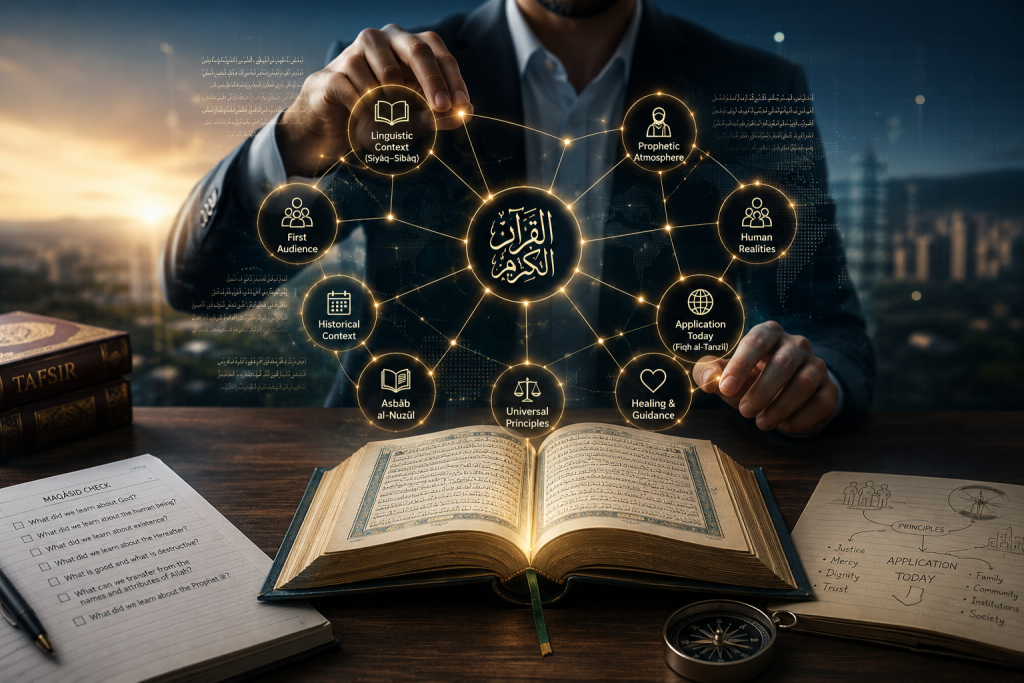
These great questions offer a practical method of reading.
After completing a surah, the reader can ask:
What has this surah taught me about God?
What has it revealed about the human being?
What kind of reality does it ask me to recognise?
What does it teach about life, death and responsibility?
What does it identify as good, destructive or deceptive?
What aspect of my perception, character or conduct does it seek to correct?
These questions prevent reading from becoming a collection of unrelated details. They help the reader recognise the surah’s contribution to the Qur’an’s larger worldview.
Not every surah answers every question with equal emphasis. One may concentrate upon divine mercy, another upon human denial, history, resurrection or social responsibility. Yet each adds something to the reader’s map of reality.
The purpose of this maqāṣid compass is not to force every passage into a rigid scheme. It is to remember what kind of book is being read: a book of guidance addressing God, the human being and the meaning of existence.
Conclusion
The Qur’an comes to answer the questions by which human life acquires direction.
It teaches who God is and therefore where ultimate trust belongs. It explains the human being as dignified, dependent, free and accountable. It widens reality beyond the visible world, gives life moral purpose and establishes a criterion by which good and evil may be distinguished.
It places freedom within destiny, guidance within prophethood, society within moral history and death within the horizon of resurrection and justice.
These teachings do not function as separate pieces of religious information. Together they form a world in which the human being can live meaningfully.
The Qur’an does not remove every mystery from existence. It gives us a light by which mystery can be entered without losing direction.


 By Nevzat Savas